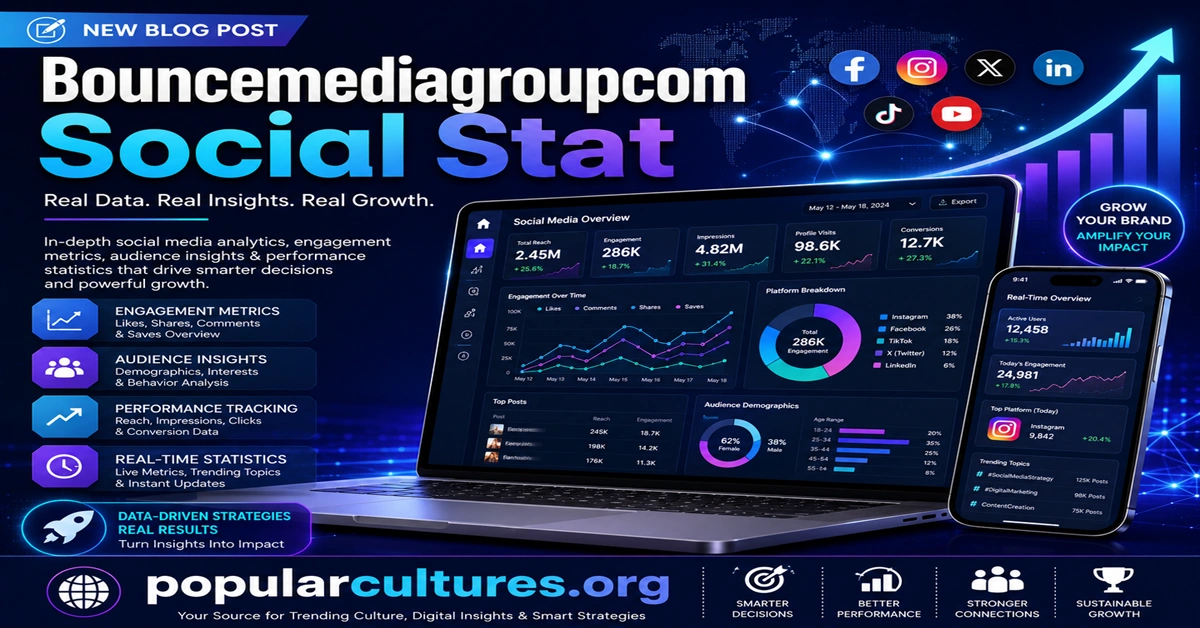
The phrase “bouncemediagroupcom social stat” has become increasingly popular among marketers, bloggers, entrepreneurs, and social media enthusiasts who want to understand how successful digital brands measure and track their online performance. At its core, the term refers to the social media statistics, engagement metrics, audience growth figures, and performance indicators associated with Bounce Media Group’s online presence. These statistics provide valuable insights into how effectively a brand connects with its audience across various social platforms.
In today’s digital economy, numbers tell stories. Every like, share, comment, click, and follower represents a signal that helps businesses understand audience behavior. Companies can no longer rely solely on intuition when creating marketing campaigns. Instead, they depend on real-time analytics to evaluate whether their content resonates with users. The growing interest in bouncemediagroupcom social stat reflects a broader trend in digital marketing where businesses seek data-driven strategies rather than assumptions.
Industry reports discussing Bounce Media Group frequently highlight engagement rates, audience growth, content performance, and platform-specific strategies as major factors behind its visibility. These metrics help marketers identify successful patterns and replicate them in their own campaigns. Understanding these social statistics is not simply about collecting numbers; it is about interpreting audience behavior and transforming insights into actionable marketing decisions. This approach enables businesses to strengthen their online presence while continuously adapting to changing consumer preferences.
Overview of Bounce Media Group’s Digital Presence
Bounce Media Group has established itself as a recognizable player in the digital marketing and media landscape. Its online presence extends across multiple social media platforms, allowing it to engage with diverse audiences through different content formats and communication styles. Rather than depending on a single platform, the company distributes its efforts strategically to maximize reach and engagement. This multi-platform approach creates greater brand visibility while reducing dependence on any one channel.
Reports analyzing the company’s social media footprint indicate a strong focus on audience interaction, content consistency, and platform-specific optimization. Bouncemediagroupcom social stat channels such as Instagram, Facebook, LinkedIn, TikTok, and other networks serve distinct purposes within the broader marketing ecosystem. Instagram may focus on visual storytelling, while LinkedIn emphasizes professional networking and thought leadership. This tailored strategy allows the company to communicate effectively with different audience segments.
One of the most important lessons marketers can learn from Bounce Media Group’s digital presence is the value of diversification. Social media algorithms change frequently, and audience preferences evolve rapidly. By maintaining visibility across multiple platforms, brands can remain resilient despite shifts in digital trends. Consistent activity, regular audience engagement, and a commitment to producing relevant content all contribute to long-term growth. As a result, Bounce Media Group’s social performance has become a topic of interest for businesses seeking practical examples of successful digital marketing execution.
Key Social Media Metrics Explained
To understand bouncemediagroupcom social stat properly, it is essential to examine the key metrics that drive social media performance. These measurements act as performance indicators that reveal how effectively a brand communicates with its audience and achieves its marketing objectives.
| Metric | Purpose | Why It Matters |
|---|---|---|
| Engagement Rate | Measures interactions | Shows audience interest |
| Reach | Tracks visibility | Indicates brand exposure |
| Impressions | Counts content views | Measures content distribution |
| CTR | Tracks clicks | Evaluates user action |
| Follower Growth | Monitors audience expansion | Indicates long-term momentum |
Engagement rate is often considered the most important metric because it measures how actively users interact with content. Likes, comments, shares, saves, and reactions all contribute to engagement levels. High engagement typically indicates that content resonates strongly with the audience. According to various analyses, Bounce Media Group places significant emphasis on engagement as a core performance indicator.
Reach and impressions are equally important. Reach measures the number of unique users who see content, while impressions track the total number of times content is displayed. Together, these metrics reveal how effectively content is distributed across bouncemediagroupcom social stat networks. A post with high reach but low engagement may indicate that the content is visible but not compelling enough to encourage interaction.
Follower growth serves as a long-term indicator of brand health. Consistent audience growth suggests that a company’s content strategy is attracting new users while retaining existing followers. Click-through rate (CTR) measures how frequently users click on links, making it a critical metric for evaluating traffic generation and conversion potential.
Platform-by-Platform Social Performance
Different social media platforms serve unique purposes, and Bounce Media Group appears to adapt its strategy accordingly. This platform-specific approach allows the brand to maximize engagement while addressing the unique expectations of each audience segment.
Instagram Performance
Instagram remains one of the most important channels for visual storytelling and audience engagement. Public analyses suggest that Bounce Media Group maintains strong activity on Instagram, utilizing reels, stories, behind-the-scenes content, and educational posts to engage followers. Some reports estimate engagement rates ranging between 4% and 6%, which exceeds many commonly cited industry averages.
Facebook Presence
Facebook continues to be valuable for community building and content distribution. Bounce Media Group reportedly uses Facebook to share blog content, case studies, event announcements, and audience discussions. The platform supports longer-form communication and enables deeper interactions through comments and community engagement.
LinkedIn Authority
LinkedIn serves as the company’s professional networking hub. Content often focuses on industry insights, leadership perspectives, employee highlights, and client success stories. This strategy helps position the brand as a knowledgeable authority within the digital marketing sector. Reports indicate steady growth in professional engagement and visibility on the platform.
TikTok and Short-Form Video Growth
Short-form video continues to dominate social media trends. Bounce Media Group has reportedly embraced TikTok and video-centric formats to capture attention quickly and increase audience engagement. Video content often receives higher interaction rates than static posts, making it a valuable component of modern content strategies.
Content Strategy Behind the Numbers
Behind every successful social media statistic lies a carefully planned content strategy. Bouncemediagroupcom social stat growth does not happen by accident. It requires consistency, creativity, audience understanding, and ongoing optimization.
Bounce Media Group’s reported approach emphasizes content diversification. Rather than relying on a single content format, the company utilizes videos, graphics, articles, polls, educational content, client success stories, and interactive campaigns. This variety helps maintain audience interest while catering to different user preferences. Some followers may prefer quick videos, while others engage more with in-depth educational content. By offering multiple formats, the brand increases its opportunities for engagement.
Consistency is another critical factor. Social media algorithms reward active accounts that post regularly. Maintaining a predictable publishing schedule keeps audiences engaged while improving visibility. Successful brands understand that social media is a long-term investment rather than a short-term campaign. Like building a relationship, audience trust develops gradually through repeated positive interactions.
Timing also plays a significant role. Publishing content when audiences are most active increases the likelihood of engagement. Analytics tools help marketers identify optimal posting times, allowing them to maximize reach and interaction. This data-driven approach ensures that content reaches users when they are most receptive to engaging with it.
Audience Demographics and Behavior
Understanding audience behavior is one of the most valuable aspects of social media analytics. Metrics alone provide numbers, but demographic analysis reveals the people behind those numbers. Successful brands study audience age groups, geographic locations, interests, professions, and online behaviors to create more relevant content.
Bounce Media Group reportedly analyzes audience demographics to refine its marketing strategies and improve content targeting. This information helps marketers understand which topics generate the most engagement and which content formats resonate with specific audience segments. Such insights allow businesses to allocate resources more effectively while improving campaign performance.
Audience loyalty often develops through consistent value delivery. People follow brands that educate, entertain, solve problems, or inspire them. When content consistently meets audience expectations, engagement increases naturally. This creates a positive feedback loop where stronger engagement improves visibility, leading to additional audience growth.
Community building also contributes significantly to long-term success. Responding to comments, encouraging discussions, and acknowledging user contributions helps strengthen relationships between brands and followers. Social media is no longer a one-way communication channel. Modern audiences expect conversations, not broadcasts. Brands that embrace this reality often experience stronger engagement and retention rates.
Social Stats Comparison and Industry Benchmarks
Numbers become more meaningful when viewed in context. Industry benchmarks provide reference points that help marketers evaluate performance realistically. A bouncemediagroupcom social stat media engagement rate may appear low or high depending on the platform, industry, audience size, and content type.
Several public discussions surrounding Bounce Media Group suggest engagement levels that compare favorably with industry averages. While exact figures remain difficult to independently verify, reported engagement estimates generally exceed many benchmark studies for social media marketing accounts. This indicates that the company focuses on quality interactions rather than merely accumulating followers.
One common mistake businesses make is focusing exclusively on vanity metrics. Large follower counts may look impressive, but they provide limited value if audiences remain inactive. Engagement, conversions, website traffic, and lead generation often offer a more accurate picture of marketing effectiveness. Bounce Media Group’s social stat discussions consistently emphasize these deeper performance indicators rather than follower counts alone.
Benchmarking also helps identify opportunities for improvement. If a company’s engagement rate falls below industry standards, it may signal issues with content quality, targeting accuracy, or posting frequency. Continuous comparison and optimization enable businesses to remain competitive in crowded digital markets.
Future Trends for Social Media Analytics
The future of social media analytics is being shaped by artificial intelligence, automation, predictive modeling, and advanced audience segmentation. Traditional metrics such as likes and shares remain valuable, but businesses increasingly seek deeper insights into customer behavior and conversion pathways.
AI-powered analytics tools can now identify patterns that would be difficult for humans to detect manually. These systems analyze massive datasets, uncover emerging trends, and recommend optimization strategies in real time. Bounce Media Group and similar organizations are expected to benefit from these technological advancements as they continue refining their digital marketing efforts.
Personalization will also become increasingly important. Future analytics platforms will focus on delivering highly customized content recommendations based on individual user behavior. This shift will allow marketers to create more relevant experiences, resulting in higher engagement and conversion rates.
Video analytics, sentiment analysis, and cross-platform attribution models are likely to become standard components of modern marketing dashboards. Businesses that embrace these innovations will gain deeper insights into audience preferences while improving campaign performance. As bouncemediagroupcom social stat media ecosystems continue evolving, data-driven decision-making will remain at the center of successful digital marketing strategies.
Conclusion
The growing interest in bouncemediagroupcom social stat highlights the importance of social media analytics in today’s digital landscape. Whether examining engagement rates, follower growth, reach, impressions, or conversion metrics, these statistics provide valuable insights into how brands build relationships with audiences and achieve marketing success.
Bounce Media Group’s reported social media performance demonstrates the value of a diversified platform strategy, consistent content creation, audience-focused communication, and data-driven optimization. While public statistics should always be interpreted carefully, the broader lessons remain highly relevant for marketers and business owners seeking sustainable growth.
Success on social media is not about chasing vanity metrics or viral moments. It is about understanding audience behavior, delivering meaningful content, and continuously refining strategies based on measurable results. Businesses that embrace these principles position themselves for long-term visibility, engagement, and growth in an increasingly competitive digital world.
FAQs
1. What does bouncemediagroupcom social stat mean?
It generally refers to the social media performance metrics, audience engagement data, follower growth statistics, and platform analytics associated with Bounce Media Group.
2. Why are social media statistics important?
Social media statistics help businesses measure audience engagement, track growth, evaluate campaign effectiveness, and make data-driven marketing decisions.
3. Which metrics are most important in social media analytics?
Key metrics include engagement rate, reach, impressions, click-through rate (CTR), follower growth, conversions, and audience retention.
4. How does Bounce Media Group reportedly achieve strong engagement?
Public analyses suggest the company focuses on content diversification, consistent posting schedules, audience interaction, and platform-specific content strategies.
5. What is the future of social media analytics?
Future trends include AI-powered analytics, predictive insights, advanced audience segmentation, personalized content recommendations, and more sophisticated conversion tracking systems.